|
MANILA, Philippines -Lanzones is one
of the country’s oldest and most loved fruits. It is a
lucrative s ource of income for fruit tree farmers
especially those from Southern Luzon, Camiguin, Davao and
Jolo.
Fruit expert Dr. Bernardo O. Dizon, more popularly called
“Ka Bernie,” is recommending the double-rooted technology in
the propagation of Longkong lanzones, a variety that comes
from Thailand and Malaysia and which has overtaken our local
variety of native lanzones.
He said native lanzones could be coaxed to bear fruits in
five years after planting. This is made possible by
double-rooted stocking the Longkong variety coming from
Thailand and Malaysia. On the other hand, direct seed
propagation, as is the usual local practice with the Paete
variety, takes 15 to 20 years before the plant starts to
bear fruit.
The differences are also apparent in the price. The Longkong
variety which is sweeter than the Paete variety, sells at
P250 per kilo wholesale, and P350 up to P600 per kilo retail
when supply cannot keep up with the demand. The Paete
variety has a wholesale price of P40 per kilo and retail
price of from P60 to P80 per kilo.
As far back as the late 80’s, Ka Bernie has been
promoting high-value fruit trees such as latex-less
jackfruit or langka, Sweet Angge guyabano, seedless atis,
mangosteen, imported mangoes, rambutan, durian, pomelo, and
other popular and marketable native fruit trees.
Citing the market-potential of the Longkong lanzones, Ka
Bernie said fruits produced from Mindanao are being sold in
Metro Manila fruit stands “as imported from Thailand.”
Noting the capability of the Longkong to grow well and fruit
abundantly under local conditions, he said he has
successfully top-worked over Paete or Jolo varieties and the
results proved “promising and profitable.”
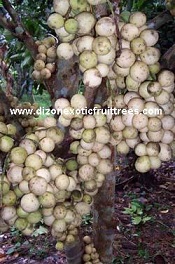
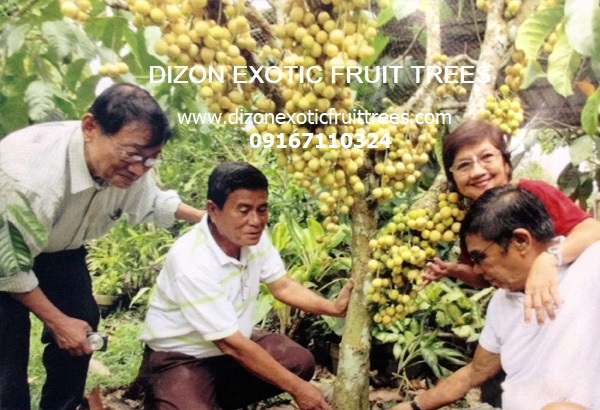
He said Longkong fruits come in compact bunches, some are
seedless and others have very small seeds and latex-tree,
with its delicate taste a blend of a very light hint of
sourness and hearty sweetish tingle.
Ka Bernie’s Longkong double-rooted seedlings have found
their way all over Luzon and their proud owners gush over
its “profitability” and “continuous fruiting capabilities.”
Rep. Salacnib Baterina had reported that the lanzones, Thai
rambutan and Davao pomelo in Ilocos Sur and nearby provinces
are fruiting even out of season. “Too bad only a few of the
double-rooted fruit trees which were procured from your
project at the center were planted there.”
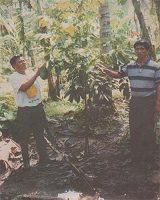
In La Paz, Abra, orchard owner Henry Dupo, takes pride in
reporting that his seven-year-old double-rooted Longkong
lanzones had been giving him an average of 25 kilos per tree
every harvest time.
Dupo recently returned to the Ninoy Aquino Parks and
Wildlife Center, in Quezon City to report on what he calls
“his lifetime investment in Longkong that paid off
handsomely.” Expanding his area for double-rooted Longkong
lanzones production, Dupo remarked, “I now have full
evidence of the popular bucolic saying ‘money grows on
trees.’”
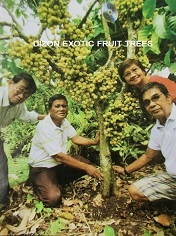
One of the most excited owners of the Longkong kind, is
lawyer Victor P. Lazatin, who runs an 11-hectare farm
diversified fruit farm in Tiaong, Quezon. An avid collector
of exotic fruit trees, several of them sourced from
Thailand, Malaysia and USA, he prides most his long rows of
heavily-fruiting Longkong. He advises both full-time orchard
and leisure farmers to go heavy on planting double-rooted
varieties of high-value Longkong lanzones, latex-less
jackfruit or langka, chocanan fruit trees and others being
promoted by Ka Bernie Dizon.”
In his family farm resort in Lucena, Quezon, former PNP
Chief Gen. Recaredo Sarmiento II, says his double-rooted
Longkong fruit trees – yielding fruits twice-a-year – are
his resort’s star attraction and source of family income.
Last trees standing in their place while single-rooted trees
have been uprooted or felled by strong typhoons.
Mario Calayco, who owns an orch ard in Poblacion, President
Roxas, North Cotabato, takes pride in his regularly
heavily-fruiting 500 Longkong trees. His secret, he says is
Ka Bernie’s technology “double-rooted technology. He calls
his Longkong and rambutan trees “My champion longkong and
rambutan.” He ships huge orders of the fruits to Manila.
A proudly standing testimony to the multi-faceted
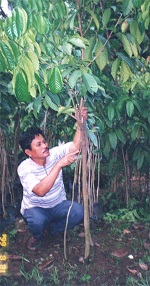
characteristics of multiple rooted technology are the 200
double-rooted Longkong trees planted by Ka Bernie 12 years
ago in Asian College of Science and Technology (ASCOT),
Valencia, Negros Oriental; also planted in the school
grounds were 600 single-rooted Longkong. ASCOT owner
Constancio Cia attests to his findings that double-rooted
trees produced three times more than the singles. Also, the
double-rooted ones while flowering, there fruit sets, buds
and ripe fruits. The singles bear fruits every two years.
Lawyer Antonio Partosa Jr., an orchard farmer, rues the day
when he said he listened to the counsel of a regional
agricultural official to just plant single-rootstock fruit
tree seedlings, including Longkong lanzones. Optimistic in
pursuing the route of the double-rooted technology, he was,
however discouraged by Department of Agriculture people
saying it was just a waste of time, and would have no good
effect. “I Now harvest from my single Longkong trees every
two years (biennial fruiting). Now, he said he has had a
change of heart and pursuing completely Ka Bernie’s
double-rooted technology.
In Nueva Ecija, at the Central Luzon State University,
Science City of Muñoz, and the Nueva Ecija University of
Science and Technology(NEUST)-Gabaldon Compound, Gabaldon,
Nueva Ecija, Longkong lanzones bear fruits in the month of
May.
Fruiting season in Southern Luzon and Mindanao are the
months of August, September and October.
As shown from the varying fruiting season of fruits, say,
Longkong lanzones, latex-less jackfruit or langka, and
others, it is very easy and possible to plant trees and
propagate anywhere in the country especially considering the
breakthroughs established by Ka Bernie.
Taken collectively, a massive propagation of the
aforementioned high-value fruit trees, would not only serve
as the answer to the call for effective means of combating
climate change but provide work and income-generation
projects in the countryside.
|